 Image 1 of 1
Buckle up! The golden spike has just been driven, and the nation is officially connected from coast to coast. In this immersive simulation, students step into the shoes of a government advisor reporting to Congress in 1869, unraveling the story of how the Transcontinental Railroad was built, who built it, and what it cost. From explosive mountain tunnels to immigrant labor and the displacement of Native nations, each exchange challenges students to balance the triumph of progress with the toll it took.
Once they’ve survived their congressional questioning, students move on to the “Tracks of Two Tales” extension project. A creative, comparative visual analysis where they explore two sides of the railroad’s legacy. Whether they choose to represent a Chinese railroad worker and a wealthy tycoon or a Native leader and a Western merchant, students visually capture both the promise and the price of American expansion.
This isn’t just another railroad lesson! It’s an interactive, empathy-building journey through one of the most transformative moments in U.S. history.
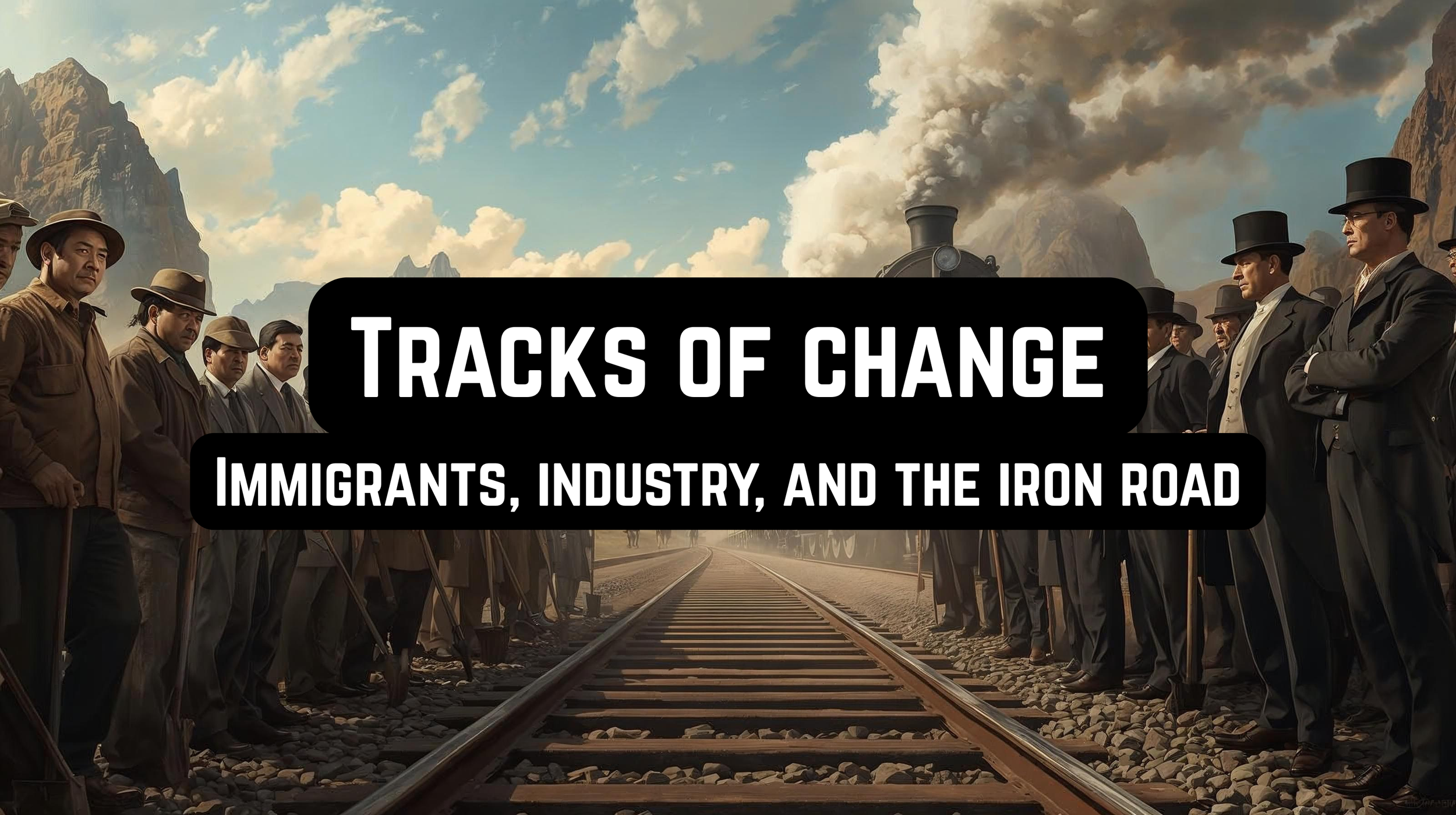
Tracks of Change: Historical Context & Visual Companion - This student-facing resource (Immigrants, Industry, and the Iron Road) provides essential background on the railroad’s construction, immigrant labor conditions, and Plains Indian resistance. It is built to prepare students for the simulation while grounding their analysis in historical accuracy.
Tracks of Change: Simulation Instructions - Students assume the role of a New York Times correspondent in 1877, traveling from Omaha to Utah Territory to report on the sweeping transformation of the West. They’ll conduct a series of guided “interviews” with figures such as a railroad foreman, a Chinese laborer, a Lakota leader, and a U.S. Army officer, piecing together multiple perspectives on progress, labor, and resistance.
Extension project:Tracks of Two Tales: The Promise and the Price of Progress - Students synthesize their learning by comparing two opposing perspectives in a creative split-poster or digital slide deck. Through “The Promise” and “The Price,” they illustrate how the railroad symbolized both opportunity and injustice. A final reflection challenges them to answer the key question: Was the Transcontinental Railroad a symbol of progress, a source of injustice, or something in between?
Extension Activity Rubric aligned to Georgia Standards of Excellence
Buckle up! The golden spike has just been driven, and the nation is officially connected from coast to coast. In this immersive simulation, students step into the shoes of a government advisor reporting to Congress in 1869, unraveling the story of how the Transcontinental Railroad was built, who built it, and what it cost. From explosive mountain tunnels to immigrant labor and the displacement of Native nations, each exchange challenges students to balance the triumph of progress with the toll it took.
Once they’ve survived their congressional questioning, students move on to the “Tracks of Two Tales” extension project. A creative, comparative visual analysis where they explore two sides of the railroad’s legacy. Whether they choose to represent a Chinese railroad worker and a wealthy tycoon or a Native leader and a Western merchant, students visually capture both the promise and the price of American expansion.
This isn’t just another railroad lesson! It’s an interactive, empathy-building journey through one of the most transformative moments in U.S. history.
Tracks of Change: Historical Context & Visual Companion - This student-facing resource (Immigrants, Industry, and the Iron Road) provides essential background on the railroad’s construction, immigrant labor conditions, and Plains Indian resistance. It is built to prepare students for the simulation while grounding their analysis in historical accuracy.
Tracks of Change: Simulation Instructions - Students assume the role of a New York Times correspondent in 1877, traveling from Omaha to Utah Territory to report on the sweeping transformation of the West. They’ll conduct a series of guided “interviews” with figures such as a railroad foreman, a Chinese laborer, a Lakota leader, and a U.S. Army officer, piecing together multiple perspectives on progress, labor, and resistance.
Extension project:Tracks of Two Tales: The Promise and the Price of Progress - Students synthesize their learning by comparing two opposing perspectives in a creative split-poster or digital slide deck. Through “The Promise” and “The Price,” they illustrate how the railroad symbolized both opportunity and injustice. A final reflection challenges them to answer the key question: Was the Transcontinental Railroad a symbol of progress, a source of injustice, or something in between?
Extension Activity Rubric aligned to Georgia Standards of Excellence